Best Physics Tutor in Salt Lake, Kolkata: How to Choose Well for JEE, NEET and Boards
By Amit Sharma
Founder & Physics Mentor, GRIT Classes • October 15, 2026
If you live anywhere between Sector 1 and Sector 5, you have probably already collected three or four phone numbers from relatives, building neighbours and school WhatsApp groups, each one attached to a confident recommendation. That is how most searches for the best physics tutor in Salt Lake Kolkata begin — not with research, but with a handful of names and no reliable way to rank them. The difficulty is that every tutor sounds similar on a phone call. Everyone covers the syllabus. Everyone mentions toppers. Everyone has a demo class ready.
This article is an attempt to give you something sharper than a phone call. It lays out what actually differentiates a strong physics tutor from an adequate one, how the demands of JEE, NEET and the Class 11–12 boards pull in slightly different directions, and what a verifiable track record looks like when you see one. It also puts a specific name under the microscope — Amit Sharma, former Head of the Physics Department at FIITJEE Kolkata North and founder of GRIT Classes — including his teaching methods, his approach in a classroom, and the educational philosophy underneath both, along with the published ranks his students have produced.
One honest caveat before we start. There is no single correct answer to who the best physics teacher in Salt Lake Kolkata is, because fit matters and fit is personal. A student who needs patient repetition and a student who needs to be pushed hard will not thrive under the same teacher. What this piece can do is give you the right questions, so that whichever name you finally choose, you choose it for reasons you can defend a year later.
Why Salt Lake Became a Coaching Address — And Why That Alone Proves Nothing
Salt Lake, or Bidhannagar if you prefer the official name, ended up with an unusually high density of coaching institutes for fairly ordinary reasons. The blocks are planned and walkable. The schools are good and clustered. Sector V brought in a professional population that values structured education and can pay for it. Metro connectivity on the East–West line stitched the township into the rest of the city. Put those together and you get a neighbourhood where a serious institute can fill batches without needing students to travel for ninety minutes each way.
That is genuinely useful. A student who reaches class in fifteen minutes attends more consistently, arrives less tired, and has more hours left for self-study than one crossing the city twice a day. Over two years of preparation, that difference compounds into something real.
But proximity is a convenience, not a credential. The most common error in this whole process is treating a Salt Lake address as a quality signal. The signboard tells you where a tutor rents a room. It tells you nothing about whether he can look at a student's half-finished solution and identify, in ten seconds, that the problem is not the chapter but a shaky grasp of vector components from eight months ago. A top physics tutor in Salt Lake City Kolkata and a mediocre one may sit on the same street, charge similar fees, and advertise identically.
So the right way to use geography is as a filter applied second, not first. Decide what good physics teaching looks like. Then ask which of the people who meet that bar happen to be reachable from your block. Reversing that order is how families end up two months into a batch, quietly realising their child has stopped asking questions in class.
Salt Lake Is Where the Classroom Is — Not Where the Students Are From
Worth clearing up, because the search term can mislead. GRIT Classes has its offline coaching located in Salt Lake, with a second centre in Durgapur, but the batches are not a Salt Lake neighbourhood affair. Students travel in from across the city — Lake Town and Dumdum, Beliaghata and Phoolbagan, Garia and Jadavpur, Howrah and Behala, Barasat and Rajarhat — and the township's position on the East–West metro corridor is precisely what makes that practical. For a lot of families the Salt Lake centre is genuinely easier to reach than something nominally closer to home but stuck behind two bus changes.
That matters if you are reading this from somewhere else in Kolkata and assumed a Salt Lake address rules you out. It does not. And for students in the parts of the city or the suburbs where a twice-weekly commute honestly is not workable, the live online batch sits in the same classroom as the in-centre group rather than running as a watered-down parallel track — covered in detail further down.
Private Tutor, Tuition Class, or a Selected Small Batch?
The word "tutor" gets used for three fundamentally different arrangements, and most of the confusion in this search comes from comparing them as though they were interchangeable.
The One-to-One Private Tutor
Most families begin by looking for a private physics tutor in Salt Lake Kolkata, or a home physics tutor in Salt Lake Kolkata who comes to the house, on the reasonable assumption that undivided attention must be the strongest possible arrangement. Since this article names a specific institute, it should be said plainly: GRIT Classes does not offer that format. No home visits, no private sessions, no one to one physics tuition in Salt Lake Kolkata. The reason is pedagogical, not logistical.
What one-to-one teaching cannot supply is a benchmark. A student taught entirely alone has no way of knowing whether eleven minutes on a problem is fine or disastrous. There is no competitive friction, no shared test series written under identical conditions, and no exposure to a classmate who solved the same question in four steps instead of nine. Across a two-year preparation, that absence costs more than the undivided attention gains — which is exactly the gap the small-batch model below is built to close.
The Neighbourhood Tuition Class
Somewhere between the two sits the local batch of twenty or thirty students — the best physics tuition classes in Salt Lake Kolkata often operate at exactly this scale. These are frequently strong on board results, because the syllabus is covered reliably and question patterns are familiar. The weakness shows up at competitive depth. Many such classes teach to the board paper and treat JEE-level problems as optional extras, which is fine until a student sits a mock test and discovers that the questions do not resemble anything they have practised.
The Institute That Keeps Tutor-Level Attention
The third option is an institute deliberately kept small enough that the senior faculty member still teaches every session and still knows each student's weak chapters by name. This is the model GRIT Classes runs, and it is worth being specific about why it matters. The usual trajectory of a successful coaching brand is that the founder teaches brilliantly for a few years, enrolment grows, and the actual teaching gets handed to junior staff while the founder's name stays on the hoarding. Families keep paying for a reputation that is no longer in the room.
Keeping batches small is the only structural defence against that drift. It caps revenue, which is presumably why most institutes do not do it. It also means that when a student's test score drops eight marks, the person who notices is the person who taught the chapter. And because the group is small, attention is distributed evenly rather than rationed — nobody has to be loud or privileged to be noticed, which is the practical benefit families underestimate most.
There is a second structural piece that makes this work, and it is the part applicants are usually surprised by: admission is not open. Every student sits a selection test before joining, and whether they join, and which batch they join, is decided by that result. The filter is not exclusivity for its own sake. A batch whose students sit at a comparable level can be taught at one honest pace, and that is precisely what allows a single teacher to give every student in the room an equal share of attention. Mixed-ability batches force a teacher to quietly choose whom to lose.
Amit Sharma of GRIT Classes — A Detailed Profile
Because this article names a specific person, the claims about him should be checkable. Here is the background, the method, and the thinking behind the method.
Background and Credentials
Amit Sharma spent a significant part of his career as Head of the Physics Department at FIITJEE Kolkata North before founding GRIT Classes. That distinction deserves a moment, because "ex-FIITJEE faculty" is a phrase many tutors in Kolkata can claim with varying degrees of accuracy. Heading a department is a different job from teaching a batch. It means setting the standard other faculty teach to, reviewing their material, training new teachers, and carrying accountability for results across many classrooms rather than one. You cannot do that work for years without developing an unusually clear sense of which teaching habits produce ranks and which merely produce satisfied students.
Across more than fifteen years he has taught physics to students preparing for JEE Main, JEE Advanced, WBJEE, NEET and the Class 11–12 board examinations, as well as to foundation-level students in Classes 7 to 10. That span matters more than it sounds. A teacher who only ever handles Class 12 sees the damage caused by weak Class 9 fundamentals but never gets to prevent it. Teaching across the full range builds a view of physics as one continuous staircase rather than a set of disconnected years.
Teaching Methods: What Actually Happens in the Room
Four habits define how he runs a class, and each one is a deliberate choice with a cost attached.
Derivation before shortcut. Every formula is built in front of the students before it is used. This is slower, and students who arrive expecting a sheet of results to memorise find the first few weeks frustrating. The payoff arrives in the exam hall, when a question arrives in an unfamiliar form. A student who watched the formula being assembled can reassemble it under modified conditions. A student who memorised the end product has nothing to fall back on.
Students solve where the reasoning is visible. Problems get worked at the board or on paper that the teacher reads over the student's shoulder, not silently in a notebook that gets collected later. The reason is simple: a wrong answer tells you almost nothing, while watching the first three lines of working tells you exactly where the thinking broke. Most errors in physics are not arithmetic — they are a mis-chosen reference frame, a sign convention applied by reflex, a free-body diagram drawn before the constraints were read.
Tests are diagnostics, not verdicts. Every test is followed by analysis that goes past the mark sheet into categories: which mistakes were conceptual, which were careless, which came from running out of time. Those three failures look identical on a score sheet and need completely different fixes. A student losing marks to time pressure does not need to relearn the chapter; a student losing marks conceptually will not be helped by more speed drills. This is also the mechanism that converts a routine experienced physics tutor in Salt Lake Kolkata into one who actually shifts a rank.
No chapter closes until the room can rebuild it. Coverage is not the same as comprehension, and the honest version of a syllabus plan has slack built in for the weeks when a concept needs a second pass. Rushing ahead on schedule while half the batch is lost produces a completed syllabus and an incomplete student.
Teaching Approach: Diagnose, Then Teach
The approach underneath those methods can be summarised in one sentence: find out precisely what this student cannot do, then teach that. It sounds obvious and is rare in practice, because diagnosis is slow and group teaching rewards speed.
Practically, it means the first few weeks with a new student involve a lot of questions back at them. Not "do you understand?" — students almost always say yes — but "why did you use energy conservation here instead of Newton's laws?" The answer reveals whether a correct solution came from reasoning or from recognising a question type. Those two students have identical marks and completely different futures.
It also means being willing to go backwards. A Class 12 student struggling with electrostatics may actually be struggling with the vector algebra they were allowed to skim in Class 11. Patching the current chapter leaves the fault line intact; going back three chapters feels like lost time and usually is not. This is the same logic behind starting early, which is the whole argument for a structured foundation course for JEE and NEET rather than a scramble beginning in Class 11.
Educational Philosophy
His own statement of it is short and he repeats it often enough that students quote it back:
"I believe in excellence. If a student is willing to work hard, I am committed to making him or her competition-ready."
Read it carefully and notice the structure. It is conditional, and the condition sits on the student's side. There is no promise of a rank, no claim that the right teacher can substitute for effort. What is promised is the second half — that effort honestly supplied will be met with the structure, correction and attention needed to convert it into exam readiness.
That framing has a practical consequence worth knowing before you enrol. A student looking for a teacher who will carry them without their own sustained work will find this setup uncomfortable. A student willing to put in the hours but currently unsure how to direct them is exactly who it is built for. Being clear about which of those describes your child will tell you more about fit than any demo class.
JEE vs NEET Physics — The Same Syllabus, Two Different Jobs
Parents often assume one physics teacher covers both exams identically, because the chapter list is nearly the same. The chapter list is not the exam.
A JEE physics tutor in Salt Lake Kolkata is training depth. JEE Advanced problems routinely braid two or three principles into one question — rotational dynamics tangled with energy conservation, a circuit problem that is secretly about transients — and the skill being tested is untangling which principle governs which part. That ability is built slowly, over months of problems that cannot be solved by recognising a pattern. A JEE Advanced physics tutor in Salt Lake who only drills standard question types is preparing students for the wrong paper, and the gap shows up precisely in the questions that separate the top few thousand ranks. For a fuller treatment of this, the piece on the best physics teacher for JEE in Kolkata goes deeper into what Advanced-level training requires.
A NEET physics tutor in Salt Lake Kolkata is training something closer to the opposite. NEET physics questions are mostly standard in form, but there are forty-five of them and the clock is brutal, and physics is the section where medical aspirants most often bleed marks they could have kept. The work here is accuracy under speed: recognising the question type instantly, choosing the shortest valid route, and knowing when to leave a question rather than sink four minutes into it. Students aiming for medical entrances will find the dedicated article on the best physics teacher for NEET more directly relevant.
JEE Main sits between the two, which is why a JEE Main physics tutor in Salt Lake has to teach both registers — enough depth to handle the harder questions, enough speed that the easy ones do not eat the clock. And WBJEE adds its own wrinkle with multiple-correct and differently-weighted questions, which rewards students who have practised that specific format rather than assuming JEE practice transfers cleanly.
The practical takeaway: when you speak to a prospective tutor, ask them to describe the difference between preparing a student for NEET physics and for JEE Advanced physics. A strong answer is specific and comes quickly. A vague answer about "covering the syllabus thoroughly for both" tells you they run one generic class and let the exam sort it out.
Class 11 and Class 12 Physics Tuition for CBSE and ISC Students
Not every family searching for a class 11 physics tutor in Salt Lake Kolkata is chasing an IIT seat. Plenty want a solid 90-plus in boards, a comfortable grasp of the subject, and options kept open. That is a perfectly reasonable goal and it deserves honest advice rather than being funnelled into competitive-exam intensity nobody asked for.
The useful thing to know is that a CBSE physics tutor in Salt Lake Kolkata and a JEE tutor are teaching largely the same content. The CBSE Class 11 and 12 syllabus and the JEE syllabus overlap almost entirely; what differs is how hard the questions push. This has a pleasant implication — a student taught to competitive depth rarely struggles with the board paper, because board questions are a subset of what they have been practising. The reverse does not hold. Teaching only to board difficulty leaves a student unprepared for anything harder.
Where a class 12 physics tutor in Salt Lake Kolkata earns their fee is in managing the collision that defines that year: boards, JEE Main in January and April, Advanced in May, often WBJEE in between, all while school is still running. The chapters are shared but the preparation rhythms are not, and students who treat them as three separate preparations run out of time around February. A tutor who has steered several cohorts through that calendar knows where the slack is. One who has not will keep adding to the workload until something breaks.
For students still in Class 11, the single highest-return decision is starting properly rather than starting eventually. The Class 11 preparation roadmap sets out what a realistic two-year sequence looks like, and for younger students the Class 10 foundation batch covers the groundwork that makes Class 11 survivable.
In-Centre or Online: Two Formats, One Batch
Format decisions get made on day one and then live with you for two years, so they are worth more than a minute of thought. At GRIT Classes there are only two, and they lead into the same classroom.
In-Centre at Salt Lake
The offline coaching runs from Salt Lake, with a second centre at Durgapur, and draws students from right across Kolkata rather than from the surrounding sectors alone. In-centre is still the default recommendation for most students, for an unglamorous reason: a fixed room at a fixed time removes the daily negotiation about whether to attend. Add a peer group whose pace you can measure yourself against, and a teacher who can read the room's confusion without anyone having to admit to it, and the format does a lot of work on its own.
Why There Is No Home or Private Option
Searches for a home physics tutor in Salt Lake Kolkata are common enough that the answer deserves to be unambiguous: GRIT Classes teaches in small batches only, at the centre or live online, and does not send a tutor to your home or run private one-to-one sessions in either format. Every student sits with the batch they were selected into. The small batch is what makes that workable — attention is spread evenly across the room, so a student does not need a private session to be noticed or corrected.
Live Online
An online physics tutor in Salt Lake Kolkata is no longer a compromise, provided two conditions hold. Doubts must be resolved live in session rather than queued into a chat box answered days later, and the senior faculty member must actually be teaching the online batch rather than lending a name to it while someone junior runs the class. Where those hold, online adds two real advantages: no commute, and recorded sessions that let a student rewatch the three minutes of a derivation they lost instead of sitting through an hour again.
One point about how this is actually run, because it is unusual. Students who join online are not taught separately and are not given private sessions. They clear the same selection test and sit in the same group as the selected students attending in person — same class, same questions, same tests, same pace. A student at a screen in Sector V and a student in the third row get the same share of the teacher's attention, which is possible only because the batch is small enough for that to be literally true rather than a line in a brochure.
This matters particularly for families near physics coaching near Salt Lake Sector V who are working around office hours, and for students whose school finishes late. The trade-off is self-discipline — nobody notices when attention drifts on a screen — so the stronger online programmes compensate with frequent low-stakes check-ins rather than relying on willpower. The detailed case is laid out in the article on online physics coaching in Kolkata.
Student Results — 2026 Toppers and the Longer Record
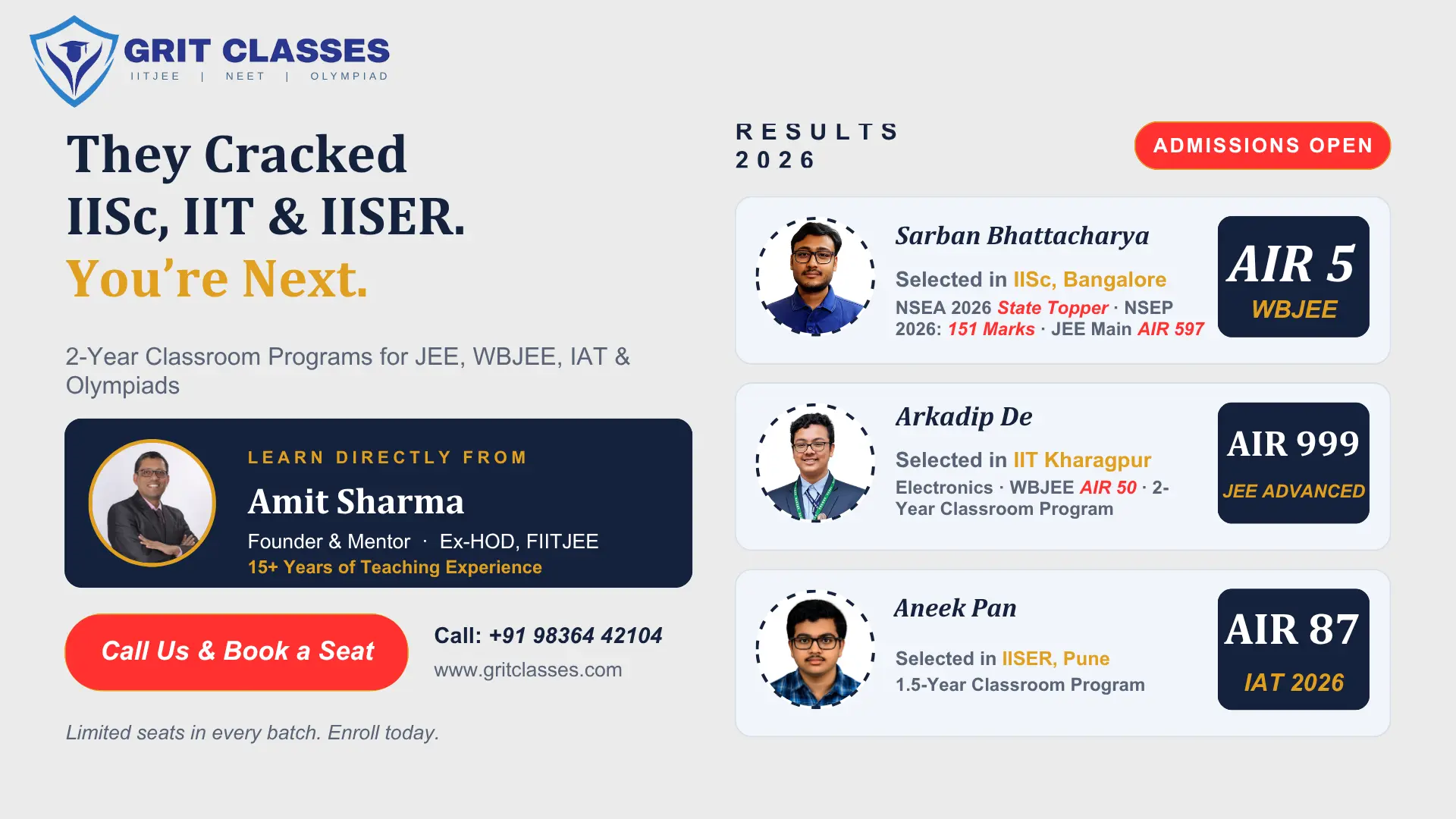
Claims about teaching quality are cheap. Rank data with names, exams and years attached is checkable, which is the only kind worth printing. What follows is the record published on the GRIT Classes results page, followed by this year's top three students in full detail.
One disclosure before the numbers, because it is the sort of thing a page like this usually hides. These are engineering-entrance results — JEE Advanced, JEE Main and WBJEE. The published record does not include NEET ranks. NEET aspirants are taught the same physics syllabus with a speed-and-accuracy emphasis, and the subject overlap is near total, but if medical-entrance rank evidence is your deciding criterion, you should know it is not in this table.
| Student Name | Examination | All India Rank | Year |
|---|---|---|---|
| Arkadip De | JEE Advanced | AIR 999 | 2026 |
| Sarban Bhattacharya | JEE Advanced | AIR 1215 | 2026 |
| Roudrabho Das | WBJEE | Rank 839 | 2026 |
| Sambit Mukhopadhyay | JEE Advanced | AIR 825 | 2025 |
| Isam Ahammed | JEE Advanced | AIR 1551 | 2025 |
| Sayan Paul | JEE Advanced | AIR 1807 | 2025 |
| Devesh Singh | WBJEE | Rank 1273 | 2025 |
| Utsav Agarwal | JEE Advanced | AIR 1187 | 2024 |
| Archisman Dandapat | JEE Main | AIR 1310 | 2024 |
| Arunangshu Karmakar | JEE Advanced | AIR 915 | 2023 |
| Utsa Ghosh | JEE Advanced | AIR 1242 | 2023 |
| Abhradeep De | JEE Advanced | AIR 1503 | 2021 |
Alongside the named results above, the broader teaching record includes a best JEE Advanced rank of AIR 415, multiple students hitting 100 percentile in JEE Main Physics specifically, a WBJEE AIR 1, and NSEP and INPhO Olympiad qualifications from students who began in the foundation years. Students interested in that track will find the physics Olympiad coaching article more detailed.
What is worth reading in this table is not the single best number but the shape of the distribution. One spectacular rank can come from one spectacularly talented student who would have done well anywhere. A spread of results clustered in the Top 2000 across six different years, in three different examinations, is harder to attribute to luck. It suggests something in the teaching system itself is doing work — and specifically, that it works for students who arrive competent rather than already exceptional, which describes most children.
2026 Toppers — Every Result, Not Just the Headline One
Most coaching pages print one rank per student, usually the most flattering one. That hides the thing worth knowing. This year's top three students each walked away with results across four, five, even six different examinations — and seeing the full sheet tells you something a single number cannot.
Sarban Bhattacharya
Selected: IISc Bangalore 2-Year Program- IIT-JEE Advanced — AIR 1215
- WBJEE — AIR 5
- JEE Main — AIR 597 · January shift 99.95 percentile, April shift 99.96 percentile
- Astronomy Olympiad (NSEA 2026) — State Topper
- Physics Olympiad (NSEP 2026) — 151 marks
- Class 12 Boards — 97.4%
Arkadip De
Selected: IIT Kharagpur (Electronics) 2-Year Program- IIT-JEE Advanced — AIR 999
- WBJEE — AIR 50
- JEE Main — AIR 1626 · January shift 99.75 percentile, April shift 99.90 percentile
- Class 12 Boards — 99.25%
Aneek Pan
Selected: IISER Pune 1.5-Year Program- IISER IAT 2026 — AIR 87
- WBJEE — AIR 290
- JEE Main — AIR 3850 · January shift 99.76 percentile, April shift 99.49 percentile
- IIT-JEE Advanced — AIR 8578
Read those three sheets side by side and a pattern emerges that is more useful than any single rank. Each of these students performed across examinations that reward genuinely different things. JEE Main punishes slow execution. JEE Advanced punishes shallow understanding. WBJEE punishes unfamiliarity with its own marking pattern. The IISER aptitude test punishes narrow preparation, since it covers four subjects in one paper. NSEP and NSEA punish anyone whose physics stops at the syllabus boundary. A student cannot tune themselves to all five at once — performing across them means the physics was actually understood.
Two details in there deserve to be pulled out. Sarban Bhattacharya finished as state topper in the 2026 Astronomy Olympiad alongside 151 marks in NSEP, while also taking WBJEE AIR 5 and a 99.96 percentile — Olympiad-level depth and board-exam discipline in the same year, which the conventional wisdom says you have to choose between. And Aneek Pan reached AIR 87 in IAT 2026 and a seat at IISER Pune on a 1.5-year program rather than the full two, which is worth noting for any student who thinks a late start has already decided the outcome.
A Seven-Step Way to Evaluate Any Physics Tutor
Use this on every name on your shortlist, including the one in this article. It takes an afternoon and saves a year.
- Fix your target first. JEE Advanced, JEE Main, NEET, WBJEE, boards, or a specific combination — the right teacher differs by target, and comparing tutors before you have settled this is comparing answers to a question you have not asked.
- Ask for rank claims with details attached. Which student, which exam, which year, which rank. A teacher with real results answers in seconds. "Many of my students got good ranks" is not an answer; it is a way of not answering.
- Ask who teaches your batch, every week, by name. Then ask what happens if that person is unavailable. The gap between the name on the hoarding and the person in the room is where most disappointment lives.
- Sit through a real class, not a demo. Demos are performances; every tutor has a polished one. A regular mid-chapter session shows you how doubts are handled, how much the students speak, and whether the pace matches your child.
- Get the batch size as a number. Not "small" — a number. Then ask how an individual doubt gets resolved in a group that size, and listen for whether the answer describes a real mechanism.
- Ask to see a filled test-analysis sheet. A current student's analysis, with names removed. If it is a score and a rank, testing is theatre. If it breaks errors into conceptual, careless and time-related categories, the feedback loop is real.
- Commit for one full test cycle before judging. Four to six weeks and at least one test. Fit rarely declares itself in a single session, and switching tutors repeatedly does more damage than staying with an imperfect but competent one.
Where Salt Lake Families Usually Go Wrong
A handful of patterns repeat often enough to be worth naming.
- Choosing by distance rather than by teaching. Fifteen minutes saved on the commute is worth very little if the teaching is average. Weigh travel time only between tutors who have already cleared the quality bar.
- Trusting the brand instead of checking the teacher. A well-known institute name says nothing about who stands in front of your child's batch on a Tuesday evening.
- Enrolling in three parallel tuitions. More classes mean less self-study, and physics is learned by solving problems alone, not by watching more of them being solved.
- Switching tutors every few months. Physics builds cumulatively and every switch costs weeks of readjustment. Change when something is genuinely wrong, not when a test goes badly.
- Mistaking comfort for progress. A class where everything feels easy is usually a class pitched below where the student needs to be. Mild, consistent difficulty is the right sensation.
- Starting in Class 12. The students with the smoothest final year are almost always the ones who built the base earlier. If your child is in Class 9 or 10, that window is open right now and will not stay open.
Format Comparison at a Glance
| Format | Works Best For | Main Limitation |
|---|---|---|
| One-to-one / home tuition (not offered at GRIT) | Undivided attention on a single student | No peer benchmark, no shared test series under exam conditions |
| Neighbourhood tuition class | Board exams, convenience, steady syllabus coverage | Often stops short of JEE Advanced-level depth |
| Small selected batch at Salt Lake | JEE, NEET and boards together, with equal attention, tracking and testing | Fixed timings; entry by selection test, seats capped by design |
| Live online, same batch | Tight schedules, Sector V families, zero commute — taught with the selected in-centre group | Demands more self-discipline; no private sessions either |
Final Thoughts
The search for the best physics tutor for JEE in Salt Lake, or the best physics tutor for NEET in Salt Lake, or simply a teacher who can get a Class 11 student genuinely comfortable with mechanics, comes down to fewer variables than the number of options suggests. Verifiable results with years and exams attached. Batches small enough that the teacher knows your child's weak chapters. Testing that produces a diagnosis rather than a score. And a senior teacher who is still actually teaching, not just named on the board outside.
Amit Sharma and GRIT Classes meet that description, with a Salt Lake centre, a published rank record going back to 2021, entry decided by a selection test rather than by who walks in first, and a teaching structure deliberately kept small enough that he remains the person in the room for every student — online or in person. Whether that is the right fit for your child is a separate question, and the only honest way to answer it is to watch a real class and ask the seven questions above.
Do that legwork with every name on your list. The families who are still satisfied with their choice eighteen months later are almost always the ones who asked uncomfortable questions in week one rather than hoping for the best. You can read more on choosing well in the guide to the best physics teacher for Class 12, or browse the rest of the GRIT Classes blog for exam-specific preparation strategy.
See a real class before you decide.
Sit in on a regular Salt Lake session — not a demo — and judge the teaching for yourself. Admission is through a short selection test, and batch sizes are capped, so availability changes through the year.
Book a Free Demo Class
Name recently joined from State.
Just now